Ciao Zio Tony Fans! Welcome back to the "Great Teteuns!" weekend in Val d' Aosta and the closing chapter of my journey to discover the unusual. However, as you are about to experience, when I finally arrived at the "signature destination" of my travels, I was overwhelmed with the notion that the more we explore the unfamiliar, the more we discover the familiar. Granted, Italian culture is not so different than our own to find the similarities incredulous. But, that’s really not the point.
It’s just that when coming across a epicurean specialty called “teteun”, described simply as “cow’s udder, to which Gignod dedicates a festival”, one’s expectations are naturally set for something out of the ordinary.
 Gignod is in the northwest Italian province of Val ‘d Aosta, not in Kansas, so; the setting is not what we’d expect for a Midwestern county fair.

But, it turns out the closer you get, the more things start looking familiar ...
 Women gossip on benches while their husbands huddle together at the bar ...

and, of course, children want to be children anywhere ...

Which may not be so unusually usual. But, if you recall my first blog post, “Ciao Cowboy”,

... and realize that the name Gran Teton (the mountain range you see in the background) shares a mammarial association with the word “teteun”, you’ll understand why I almost fell over at what I saw sauntering by ...

The dance hall was also pleasantly familiar. Actually, the only thing out of the ordinary was how these people could dance straight up & down a wall. (By the way, on a completely unrelated subject, if anybody knows how to rotate movie video, please drop ole' Uncle T a tip ). Otherwise, having spent a few years two-stepping in Texas, I easily recognized the familiar ways of the different couples: the marchers, the shufflers, the spinners, the gliders, and the two old ladies dancing together ...
Getting to the "fait accompli" of the Feta di Tetuen was no different. Standing in line at the chow hall and eves dropping on the conversations (the best I could, as my Italian still has a long way to go and the local dialect seems to be smattered with French), I found myself in the middle of a Rotary Club or Boy Scout dinner.


Except, the wine selection was much better and served only by the bottle (in this case, a plummy young "Gamay")


Granted, what you see on the plate may not stimulate a dyed in the wool vegetarian - but, I imagine it packs enough of a Pavlovian ping to trickle the salivary glands of other omnivores out there. (By the way, the "teteun" is the organ looking piece of meat in between the chops & the sausages ... :)P
In the end, it seems that one of the many joys of traveling and exploring something new, is the comforting re-discovery of where we have already been. So, I'm glad to report that the only unusual thing I discovered at the Feta di Teteun is that cow's udder is a meat that .... well ... tastes like cheese.
Ciao Zio Tony Fans! Welcome back to Part II of the "Great Tetuens" weekend, where we stick to the low gears and visit the ancestral home of everbody's favorite cognac-toting canine, the Great Saint Bernard.

As I explained in Part I, after I had mapped out the feature meal stops on my trip to Valle d' Aosta, I had to go about figuring what to do in between. Well, what better way to appreciate the mountains then by hopping on a bike and touring them by your own sweat & blood? So, searching the map from La Clusaz (3,900 ft) I picked up an interesting looking route that would take me along the Valley of Great Saint Bernard and up a mountain pass to the Swiss border at an altitude of 8,100 feet. Little did I expect what I would discover when I got there.
Here are a few shots riding up the valley. I couldn't have asked for a better day, cool temps and beautiful skies helped keep me in a good mood,

 ... even when I saw signs like this ...
 But, the climbing didn't get really tough until I cleared the tree line. You can see the long switch-backs snaking up the moutain side, leading to the pass. The road runs back to the dark ridge you see on the right side of the picture and to within a couple hundred feet of its crest,

... just beyond it lies the Hospice of Gran San Bernardo

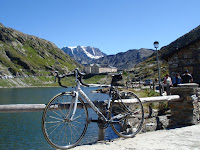

I was surprised to discover that I had arrived a quite the destination. I had hardly met any traffic coming up the Italian side; but, there where lots of visitors who I suppose came mostly from the Swiss-side. It turns out that's the direction from whence Napolean came, on his way to trounce the Austrians in 1800. Here's the Little General posing for some kiss-up named Jacques-Louis David in "Napolean Crossing the St. Bernard Pass".

Here's my version, called "Ole' Paint Crossing the Saint Bernard Pass", which I took after we had descended to the bottom of the Swiss-side valley and crawled our way back-up

... for lunch, of course.

However, I couldn't help but wonder, "What's all the barking about?" To my most pleasant surprise, I discovered that the monks who maintained the hospice were the ones who bred the Great Saint Bernard to rescue avalance victims and guide travelers safetly through blinding snow storms. A small museum maintains their history, where you can learn about real-life Super-Dog heros like "Barry" (who saved over 40 lives), study honest-to-goodness St Bernard artifacts (like doggie-snow-goggles)


... and, make your own honest-to-goodness Great Saint Bernard friends.


C
iao Zio Tony Fans! Welcome to another multipart blog post. That is, although I had originally planned my “Great Teteuns!” weekend in Valle d’ Aosta to simply sample the udderly unusual object of epicurean adoration featured in the “Feta di Teteun”, as usually happens when you open the door to a little adventure, a few unexpected surprises snuck in. So, brace your taste-buds and your quadriceps for
Part I: Welcome to Aosta, in care of the Slow Food Guide.
Part II: Passo San Bernardo, cycling to the woof-top home of the St Bernard.
Part III: How Bovine, bring your appetite and your dancing shoes to Gignod’s “Feta di Teteun”
You may recognize Valle d’ Aosta from the 2006 Winter Olympics. This most-northwestern province of Italy lies about an hour away from Torino and shares its borders with France and Switzerland. Aosta is it’s main city.


The proximity to France and it's alpine surroundings conspire to give Aosta a decidedly different atmosphere than what you might typically expect in Italy, even the street names seem from a different land. It's a pleasant town to walk through (although there is only one pedestrian street, it seems to go on forever) and with the proper guidance in hand it can be a wonderful place to stop off for lunch.

 At this point, I am compelled to make unabashed plug for Slow Food's "Osterie & Locande d' Italia" (A Guide to Traditional Places to Eat and Stay in Italy). Julie and Tim had given me this opus magnificum as a going away gift on my departure for Italy. Now, the thought of what my last six months could have been without it is downright nauseating. I am not playing to hyperbole by claiming that the only reason not to immediately tear out and throw way the “where to eat” and “where to stay” pages of any other guide or magazine article is that they may come in handy if you find yourself in a public restroom without any toilet paper. Yes, it's in English - now, stop asking questions and just get it.
That said, you should know that Zio Tony’s motto for traveling planning is, “Everything else is just figuring out what to do between meals”. So, when I first struck a fancy to explore Valle d’ Aosta, the Slow Food Guide was the first place I looked to conjure up an itinerary. In particular, this was the phrase that hooked me: “… cow’s udder, to which Gignod dedicates a festival round about 20 August". Now, honestly, who could resist?

So, it was only a matter of waiting for the calendar to roll to the third week in August before I found myself driving the 2 hours between Milano and Aosta and arriving, of course, just in time for lunch. I immediately sought out the Slow Food recommended “Trattoria degli Artisti”. Along the way, this "pasticceria" (pastry shop) reeled me in where I picked up a tasty cream filled pastry for later.

... which provides me the opportunity to report on the only “you’re clearly not one of us” intolerance I’ve experienced with Italians. You can butcher their language, overcrowd their beloved piazza’s, and fluster at the ticket counter and expect nothing but understanding smiles and calm (granted, sometimes too calm) cordial manners – but, if you want the yummy cream filled pastry that you are pointing to, for goodness sake, don’t hopelessly confound the clerk by asking for “crema” when it is actually filled with “panna” – likewise, if you’d like the other cream filled pastry next to it, don’t foolishly ask for “panna” when it is actually filled with “crema” … and, be warned not to ask for either when “crema di ricotta” is on the line. Whether or not you can actually see the “cream” inside to hazard a guess is beside the point – if you don’t know what to call it, you really don’t deserve to pay for it, much less eat it. I have experienced the same confounded reactions when trying to select a “mozzarella” or “prosciutto”. Of course, you should also know that the Italian Bureau of Health and Gastronomic Welfare strictly forbids grating cheese on your pasta when any sort of seafood is involved. As is the case with any law, “ignorance is no excuse”. Besides, why would you be so rude as to order the linguine with clams after the waiter happened to mention that the porcini were fresh? And no doubt, some of you have experienced the humiliation of trying to order a cappuccino late in the day or after dinner (“No!”). At least in this case the infamous Italian bureaucracy allows for a loop hole called the “caffe macchiato”, essentially a cappuccino served in a small espresso cup. All that said, I attribute this quirkiness to Italy’s wonderfully hyper-epicurean culture, of which we are undeniably grateful beneficiaries. So, in keeping with the “when in Rome” spirit, I have adopted a simple mantra by which my foodie-kharma has joyfully feasted on many occasions: “Mi consiglia, per piacere.” (Please recommend to me).
Which brings us back to “Trattoria degli Artisti”, located in a quite alley off of the main pedestrian drag, which at that point is called Via Aubert (like I said, the street names betray an intermingled history with the French).

I selected my lunch from their Traditional Menu. Here you see my “primo piatto” (first course), a “cotechino” (cure & cooked sausage of pork, lardo, spices, and pork rind) filled pastry accompanied by a Pinot Noir recommended by the waiter. Pour on a fondue of fontina cheese and you can imagine the risk I took of wrecking my epicurean prospects beyond the first plate. However, the cotechino proved to be relatively lean (like a summer-sausage) and the Artists really pulled it off by creating a light, you-could-almost-forget-it-was-there, pastry. The local Pinot was uncharacteristically edgy, but nonetheless both tasty and utilitarian as it cut nicely through the fondue.

Having successfully avoided the potential belly-fulls of the first course, I had plenty of capacity left to take on the second, a hearty stew of capriolo (a small alpine deer) served with rough cut polenta. It’s rich and gamey flavor left no doubt that … well ... my lunch had recently been gallivanting about the cliffs and peaks that rose up around me. To take on the touch of wilderness on my plate, the waiter poured a bold & plumy Torette Superiore into my glass. Perhaps a better trained palate could corner the Torette into a more familiar varietal, but, to me it was one of those “Well, I would have never imagined!” discoveries that you hope to stumble upon when off the beaten path.

Since I already had a pastry (filled with “panna”) in my bag and a much anticipated dinner at La Clusaz yet on the horizon, I passed on “dolce” (dessert) and went straight for the “digestivo”. I wonder if science really understands how these high-octane after-dinner elixirs work. One would think that following two full courses and a couple glasses of wine with a dram of practically pure alcohol would lower the curtains and dim the lights for nappy time. However, I have experienced the restorative powers of these gastronomical defibrillators more than once. Each region toutes it’s own “magic potion” (you are most likely familiar with “limoncello” and grappa”). So, I was curious to learn the digestivo of choice in this corner of Italy. Evoking the “mi consiglia, per piacere” mantra quickly produced a bottle “Genepy” on my table. Made from the essence of a mountain herb of the same name, it delivers a wonderfully accessible compromise between a grappa and the typical herbal "amaro" ("bitter", jagermeister is technically a digestivo).

Well, at this point, I’ve clearly rambled on too long while the new blog stories keep on piling up. Which is too bad, because I’ve only just gotten done with the first meal of the weekend. So, I will try to come back and fill you in on the fantastic dinner, which was as refined and nuanced as my lunch had been down-home-hearty, that followed at La Clusaz (another Slow Food recommendation and also where I took a room). But in the mean time, I will leave you with a copy of their “Herbal” menu (the fixed price choice I selected) to practice your Italian and your appetite. Can you guess my choices?


 Gignod is in the northwest Italian province of Val ‘d Aosta, not in Kansas, so; the setting is not what we’d expect for a Midwestern county fair.
 Women gossip on benches while their husbands huddle together at the bar ...


